
Quarterback biomechanics.
What gets measured, how a capture day runs, and what comes back to the quarterback and his team.
- Two throws, one sessionWhite: a wider base
- Stride48% → 52% of height
- Max external rotation137° → 140°
- Ball velocity48.1 → 49.0 mph
- Setup to release0.44 s → 0.40 s
Two throws from one capture, laid on top of each other: red first, then white with a wider base. This is how a change shows up.
What gets measured
Three layers, read together. None of them tells the whole story on its own.
The movement
Markerless 3D motion capture, so there are no suits or markers and the quarterback throws the way he normally does. The capture records the whole body through every throw: joint angles, segment speeds, and the order and timing the body moves in.
The ball
Ball tracking on every throw: velocity, release angle, apex, air yards, spin, and where the ball landed relative to the target. The movement only means something next to what it produced.
The body
Every assessment is read against what the athlete’s body can do. Where he already has a clinician or team staff assessing his functional movement, Biometrek works from their findings; they know him best. Where that does not exist, Biometrek runs its own movement screen in the lab with the 3D capture. Either way, a pattern in the throwing data can be traced to its cause rather than just described.
What the data shows
Timing from the snap to the plant to the release. Whether the pelvis, trunk and arm move in order, and how much each one contributes. How the feet and body are aligned to the target at the plant. Where the velocity comes from, and what it costs the arm to produce it. Which throws repeat and which ones drift.
Every measure is read against the quarterbacks Biometrek has assessed since 2019, so a younger player can see exactly where he sits against the quarterbacks Biometrek has measured, and a veteran can see what has changed since his last capture.
The load on the arm and the back
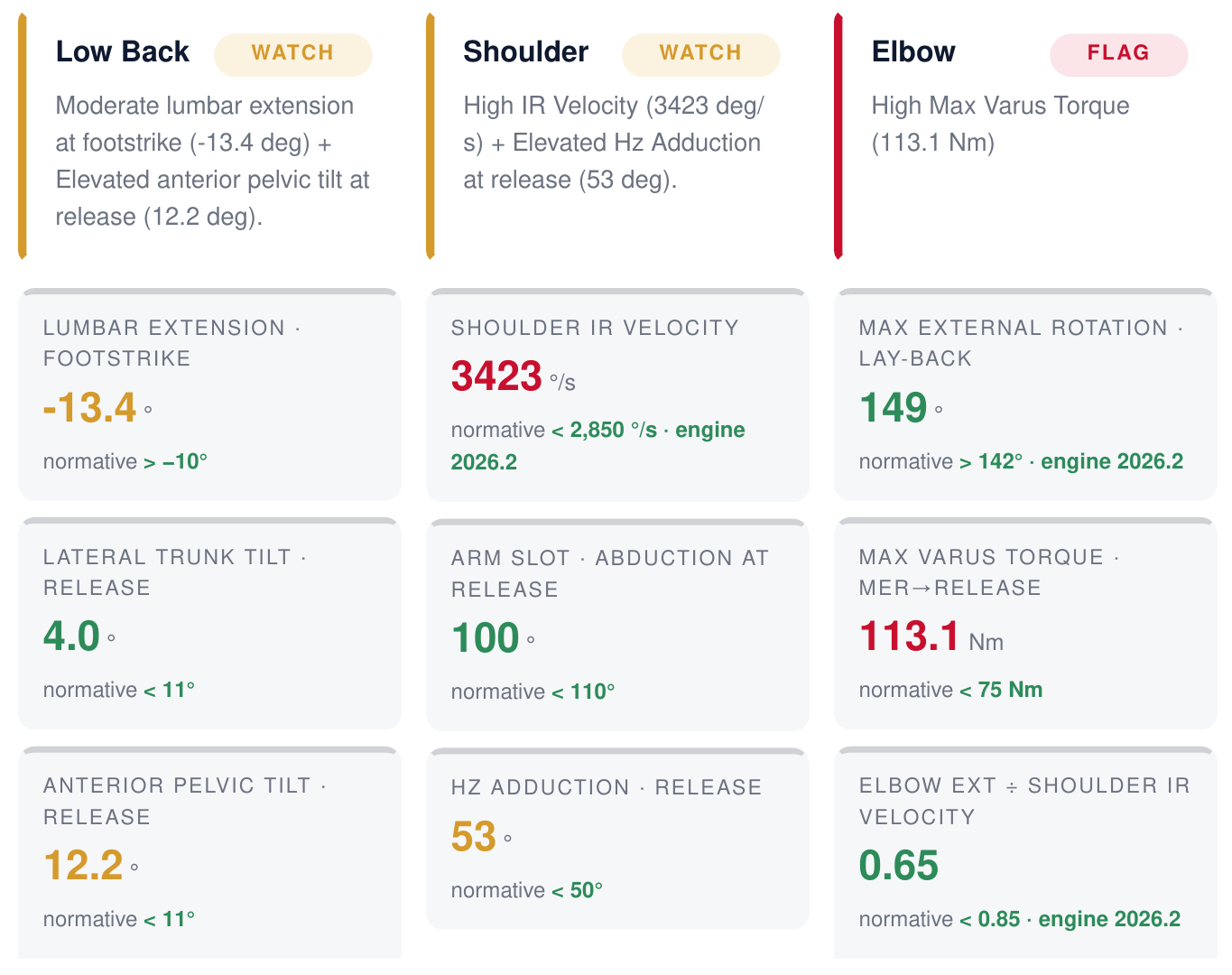
Every capture also measures what the throw asked of the shoulder, elbow and low back: the torque at the elbow, the force at the shoulder, and how much the low back extends and when. Extension at release is part of a normal throw. Extension before or during the rotation is a red flag, and it is one the eye almost never catches.
When a number points to a physical limit or a risk, it is flagged and referred to the athlete’s own medical and performance staff. Biometrek measures it; it does not treat it.
A capture day
The lab travels. It sets up at the team facility or on the field, and a full route tree takes under 15 minutes of throwing. Review with the quarterback usually happens the next morning, throw by throw, with the video beside the numbers.
The QB Insights Report follows as a private web page: the scores on consistency, command and power, the opportunities in plain language, and the clips of the throws the quarterback himself asked about.
In season
The Game Insights Report takes every throw from the game, marks the snap, plant and release by hand, and reads the timing and the platform under each one. Where the team provides the league's ball-tracking data, it is matched throw by throw. The game throws are then set against the same throws from the lab, so the quarterback can see which habits held up on Sunday and which ones did not.
Delivered each week through the season, in the same plain language as the lab report.
For teams
For a team, the lab sets up at the facility and the whole quarterback room is captured in a day. Every quarterback and the performance and medical staff receive the same report, in the same plain language, and the staff get the numbers behind it. Through the season, the game report arrives each week, so the staff can see what held up on Sunday without waiting for the next capture.
Starting
The practice is kept small on purpose. If the depth of this work is what you are looking for, get in touch.